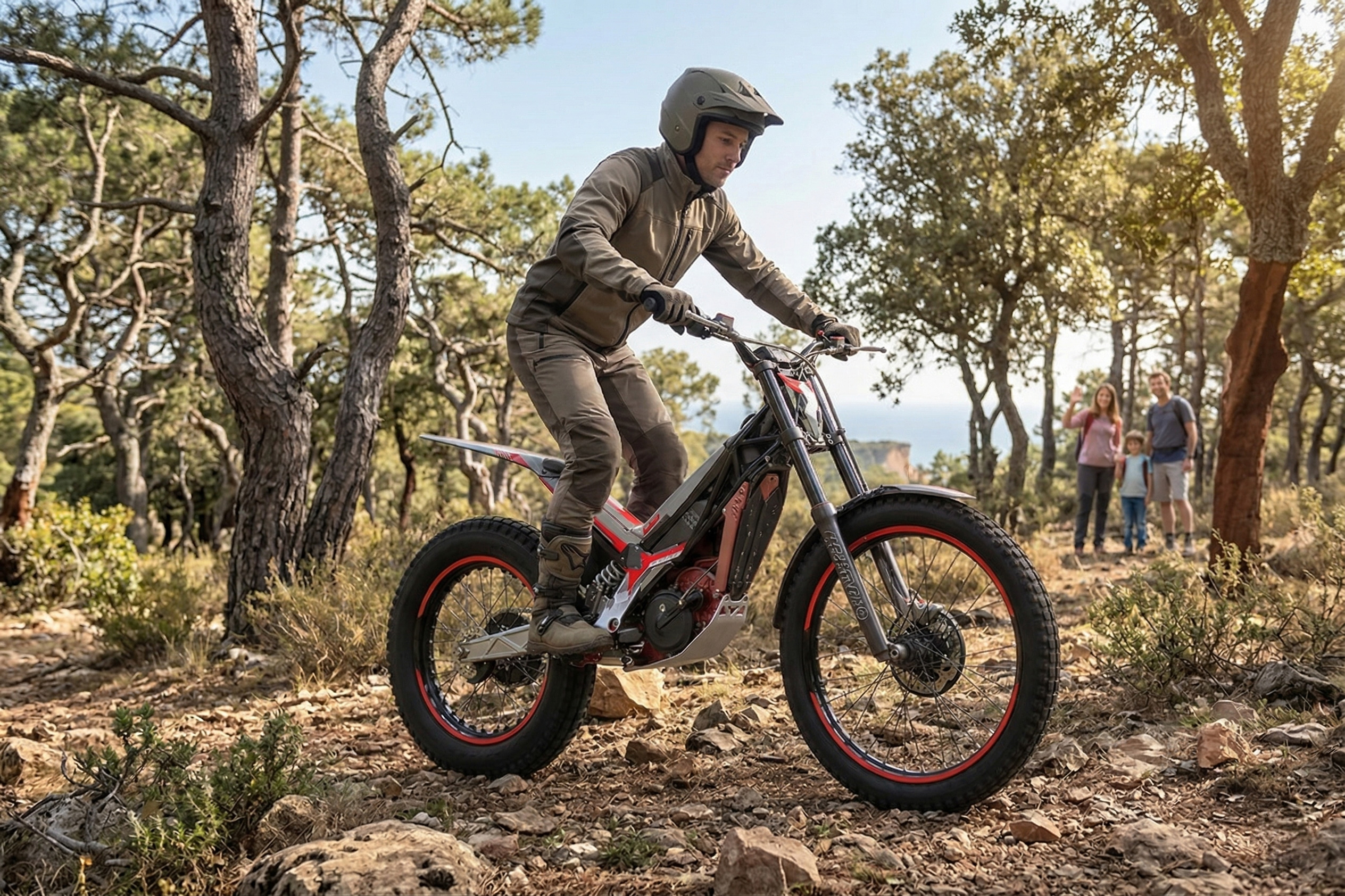
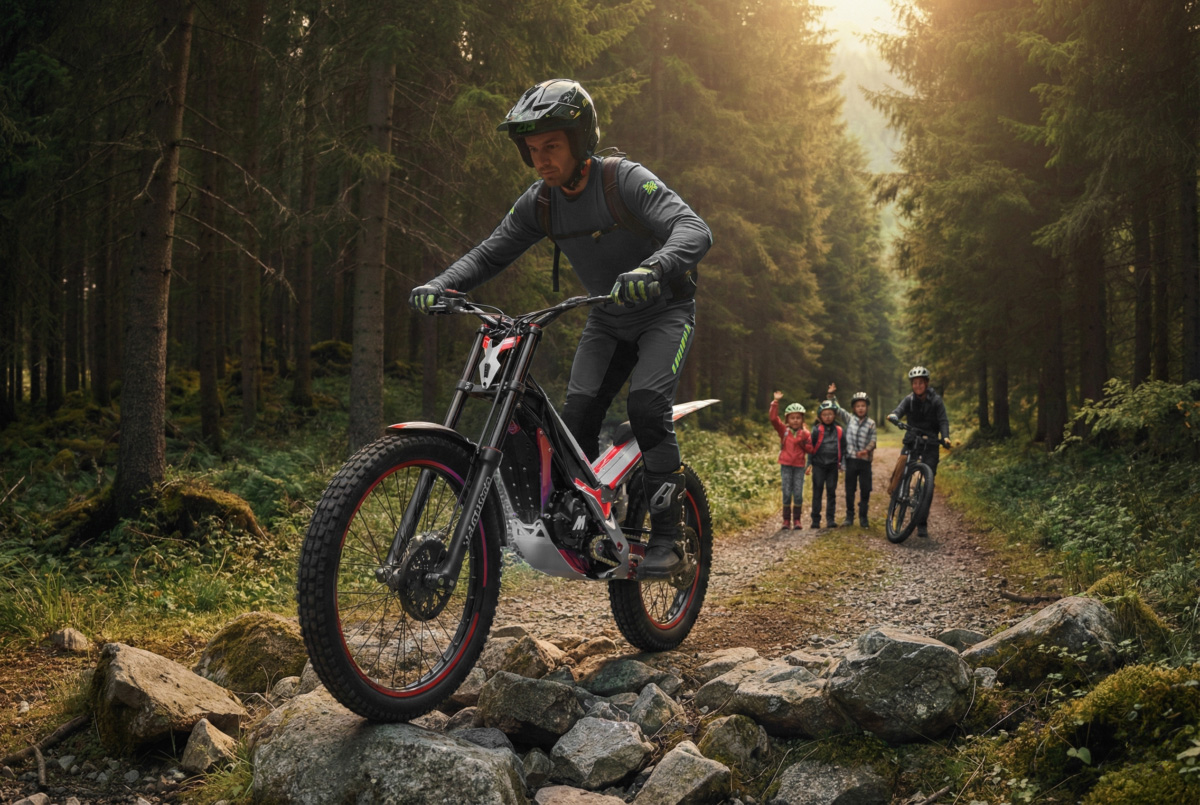
There is a very specific moment that many riders discover the first time they get on an electric motorcycle in the mountains: the instant they start it… and nothing happens. No roar, no aggressive vibration, no echo bouncing through the trees. Just movement. Just the trail.
For decades, we have associated the off-road experience with the sound of the engine: the power, the acceleration, the presence. But when that noise disappears, something unexpected happens. It’s not just the way you ride that changes; the way you perceive the environment changes too.
Suddenly you start hearing things that were previously hidden: the crunch of gravel under the tires, the wind through the pines, the water of a nearby stream. The mountain stops being just a backdrop you pass through and goes back to being a place you inhabit while riding.
Your riding transforms as well. The immediate torque delivery, the lack of gears, and the overall smoothness make the movement more fluid, more intuitive, almost organic. It is a less invasive and, paradoxically, more intense experience.
When the engine noise disappears, you discover that what you were really looking for wasn’t to make more noise in the mountains. It was to feel closer to them. And in that silence, freedom becomes different. Deeper. More real.
The silent conflict between the engine and nature
1- Noise as the source of tension in the mountains
Historically, the main point of friction between off-road motorcycles and the natural environment hasn’t necessarily been the presence of the vehicle, but the noise that accompanies it. The combustion engine, especially in open environments like forests or mountain areas, projects its sound over long distances. A group of motorcycles can be heard several kilometers before they are visible, and that acoustic impact alters the perception of tranquility that many seek when heading into nature.
This noise affects not only other mountain users—hikers, cyclists, or livestock farmers—but also the ecosystem itself. Wildlife is especially sensitive to sudden noise disturbances, causing many species to relocate or avoid certain areas when they perceive motorized activity.
The result is a conflict that rarely stems from the riders’ intentions, but rather from the way the engine’s sound invades the landscape. Although a motorcycle’s passing may be brief, the noise prolongs its presence far beyond the actual moment of transit. Thus, the sound becomes a symbol of intrusion, fueling tensions that go beyond the actual use of the vehicle.
2- The social perception of the combustion engine
Over time, the sound of the combustion engine has become an element loaded with social meaning. For those who practice off-road riding, it represents power, character, and tradition. But for many other users of the natural environment, that same sound is perceived as a sign of landscape disruption.
This difference in perception has contributed to creating an ambivalent public image of mountain motorcycling. Although most riders practice their activity responsibly, respecting trails and regulations, engine noise tends to amplify the sense of impact. A single motorcycle can disrupt the tranquility of an entire valley for a few minutes, and that experience is often etched into the memory of those who perceive it.
Over time, this perception has consolidated a narrative in which the combustion vehicle is automatically associated with noise pollution, environmental disturbance, and conflict with other mountain users. The problem is not always the activity itself, but the way it manifests in the soundscape. In many cases, noise is the first thing perceived… and the only thing remembered.
3- Growing restrictions in natural spaces
As a consequence of these tensions, many regions have seen a progressive increase in restrictions on access to natural spaces. Administrations, natural parks, and local authorities have responded to complaints from various groups by limiting access to the natural environment, establishing schedules, or closing routes that have historically been used by motorcyclists.
These measures are justified by the need to protect wildlife, preserve the tranquility of the environment, and reduce conflicts between different types of mountain users. However, for many off-road enthusiasts, these restrictions have also meant a gradual loss of spaces to practice their sport.
The result is a complex situation where mountain motorcycling finds itself in a delicate position. Even when practiced responsibly, the perceived impact of the combustion engine remains a determining factor in increasingly suffocating legal regulations.
In this context, the emergence of electric vehicles opens up a new possibility: reducing one of the elements that generates the most conflict—noise—and rethinking the relationship between off-road mobility and the natural environment.
When the noise disappears, the attitude of the environment changes
1- The drastic reduction of noise
One of the most obvious transformations when switching to an electric motorcycle is the radical reduction in noise. Where the roar of the engine used to dominate, now you barely perceive a slight hum from the electrical system and the sound of the tires on the terrain.
This change is not just a technical matter; it has an immediate effect on the riding experience and the perception of the environment. The dominant sound is no longer that of the machine, but of the landscape itself: the wind, the gravel under the wheels, the birds, or the water of a nearby stream.
For those who cross paths with an electric motorcycle in the mountains, the difference is also notable. The vehicle appears without announcing itself from afar, reducing the feeling of sonic invasion that has traditionally accompanied combustion engines.
This acoustic discretion transforms the dynamics of encounters between different users of natural spaces. The passing of the motorcycle is perceived as something brief and momentary, rather than a sonic event that invades the valley for minutes. The result is an experience much more integrated into the landscape.
2- No direct emissions in the natural environment
Another aspect that alters the relationship with the mountain is the absence of direct emissions at the point of use. Electric motorcycles do not generate exhaust gases or the characteristic smells of a combustion engine while riding through the natural environment.
In practice, this means that the immediate impact on the surrounding air is nonexistent. There is no visible smoke, no combustion-derived residues, and no oil and gas mix that traditionally accompanies off-road engines.
Although the debate on the sustainability of any technology is complex and spans the entire lifecycle of the vehicle, in the specific context of mountain use, the difference is clear: the motorcycle’s passing leaves no perceptible footprint in the form of gases, smell, or noise. This seemingly small detail helps change the general perception of the vehicle within the landscape. The experience becomes cleaner, friendlier, and less intrusive, both for the rider and for those who share the environment.
3- More respect among mountain users
Coexistence in the mountains has always been a balance between different ways of enjoying the environment: hiking, cycling, livestock farming, forestry activities, and, in some cases, off-road vehicles. When noise disappears or is significantly reduced, that balance tends to become easier to maintain.
An electric motorcycle can approach a hiker or a cyclist without generating the acoustic startle typical of a combustion engine accelerating up a hill. The encounter becomes calmer and more predictable, facilitating the usual gestures of courtesy in the mountains: reducing speed, moving slightly aside, or waving when passing by.
Over time, these small interactions help change the relationship dynamics among different users of the natural environment. Where there might previously have been a sense of invasion or annoyance, a more neutral and even curious experience now emerges.
It’s not just about technology, but about perception. When the sonic impact diminishes, the presence of the motorcycle stops dominating the scene and becomes just another element within the diversity of activities coexisting in the mountains.
Integrating into the landscape instead of interrupting it
1- Listening to the terrain instead of the engine
One of the most surprising sensations when riding an electric trials motorcycle in the mountains is discovering how much the relationship with the terrain changes when the engine stops dominating the sonic experience. Without the constant noise of combustion, the rider starts to perceive details that previously went unnoticed.
The tires’ contact with the gravel, the crunch of dry leaves, the soft thump of a rock under the rear wheel, or even the echo of your own movement in an open valley become part of the ride. The landscape ceases to be a silent backdrop behind the engine and becomes an active element of the experience.
This increased sensitivity to the terrain also influences the way you ride. Movements tend to be smoother, more precise, more attentive to what is happening under the wheels. Riding becomes less aggressive and more fluid, as if the motorcycle and the trail were in constant dialogue.
Instead of imposing on the environment through power and sound, the rider begins to read the terrain more carefully. And in that shift, the mountain stops being an obstacle to overcome and becomes a space to interact with.
2- The silent conflict between the engine and nature
For decades, the main point of friction between trials riding and other users of the natural environment has been noise. A combustion engine can be heard from hundreds of meters away, even if the rider is just practicing turns in one area.
That sound breaks the atmosphere of the place and makes an activity that actually generates very little physical impact far too conspicuous.
Often, the conflict doesn’t arise from the sport itself, but from the perception it generates. For someone walking in the mountains seeking tranquility, engine noise is interpreted as an aggression against the natural space.
Over time, this perception has led to restrictions in many areas. Not always due to actual impact, but due to the difficulty of reconciling noise with other uses of the land.
3- When the noise disappears, the attitude of the environment changes
An electric trials motorcycle transforms that situation immediately. The engine sound disappears almost completely, and what remains is the contact of the tires with the terrain. The environment recovers its natural atmosphere once again.
Another important factor is the absence of exhaust gases. Although the impact of an individual rider may be small, perception changes when smoke and fuel smells disappear.
When noise stops dominating the scene, interactions with other mountain users change. Hikers, cyclists, or families perceive the activity in a much less invasive way.
Less audible means training with more peace of mind
1- Fewer confrontations with other users
One of the factors that most influences the mountain riding experience doesn’t always have to do with terrain difficulty or riding technique, but rather coexistence with other users of the environment. Hikers, cyclists, farmers, or people simply seeking tranquility share the same trails and landscapes. In this context, the noise of the combustion engine has historically been one of the main triggers for tension.
When a motorcycle is heard from a long distance, the encounter with other users begins even before there is visual contact. The sound generates an expectation that, in some cases, is already loaded with discomfort or rejection. The presence of the vehicle is perceived as an interruption of the environment before the rider even has a chance to show a respectful attitude.
With an electric trials motorcycle, this dynamic changes notably. By drastically reducing the sonic impact, the encounter is usually more natural and less invasive. The rider can approach calmly, slow down, and cross paths with other people without startling them. This doesn’t completely eliminate the differences between activities, but it does reduce one of the elements that most easily provoked unnecessary confrontations in the mountains.
2- Less worry about bothering others
Many trials riders know well a feeling that frequently appears when training in certain areas: the constant worry about the noise the motorcycle makes. Especially near towns, recreational areas, or heavily trafficked routes, every acceleration can feel like a potential source of annoyance for those around.
This constant awareness can even influence how you train. Some riders avoid certain times of the day, shorten their routes, or even give up practicing in certain areas simply to avoid conflicts with neighbors or visitors to the natural environment.
Electric trials motorcycles greatly change this perception. By practically eliminating engine noise, the presence of the vehicle becomes almost invisible. The dominant sound becomes that of the terrain itself and the rolling of the wheels, something much less intrusive in the mountain soundscape.
This doesn’t eliminate the responsibility to ride with respect, but it does reduce the mental load associated with the possibility of bothering someone. The rider can focus more on technique, the terrain, and the riding experience, without feeling that every twist of the throttle is altering the tranquility of the environment.
3- Higher training frequency
When you combine fewer potential conflicts and less worry about acoustic impact, a very direct consequence appears: it’s easier to train regularly. Practicing trials riding requires hours of training, repeating maneuvers, and familiarizing oneself with different types of terrain, something only achieved with consistency.
However, the noise of combustion motorcycles has often limited that training frequency, especially in areas near inhabited zones or in spaces where silence is part of the place’s natural experience.
Electric motorcycles offer an interesting alternative in this regard. Their silent operation allows for much more discreet riding, making it easier to train across broader schedules and in environments where acoustic impact would be problematic with a conventional engine.
For many riders, this translates into more opportunities to practice and improve. Shorter but more frequent outings, technical training without the need to travel long distances, and a more natural relationship with the motorcycle and the terrain. Freedom, in this case, isn’t just measured in power or speed, but in the peace of mind of being able to train without disrupting the environment around you.