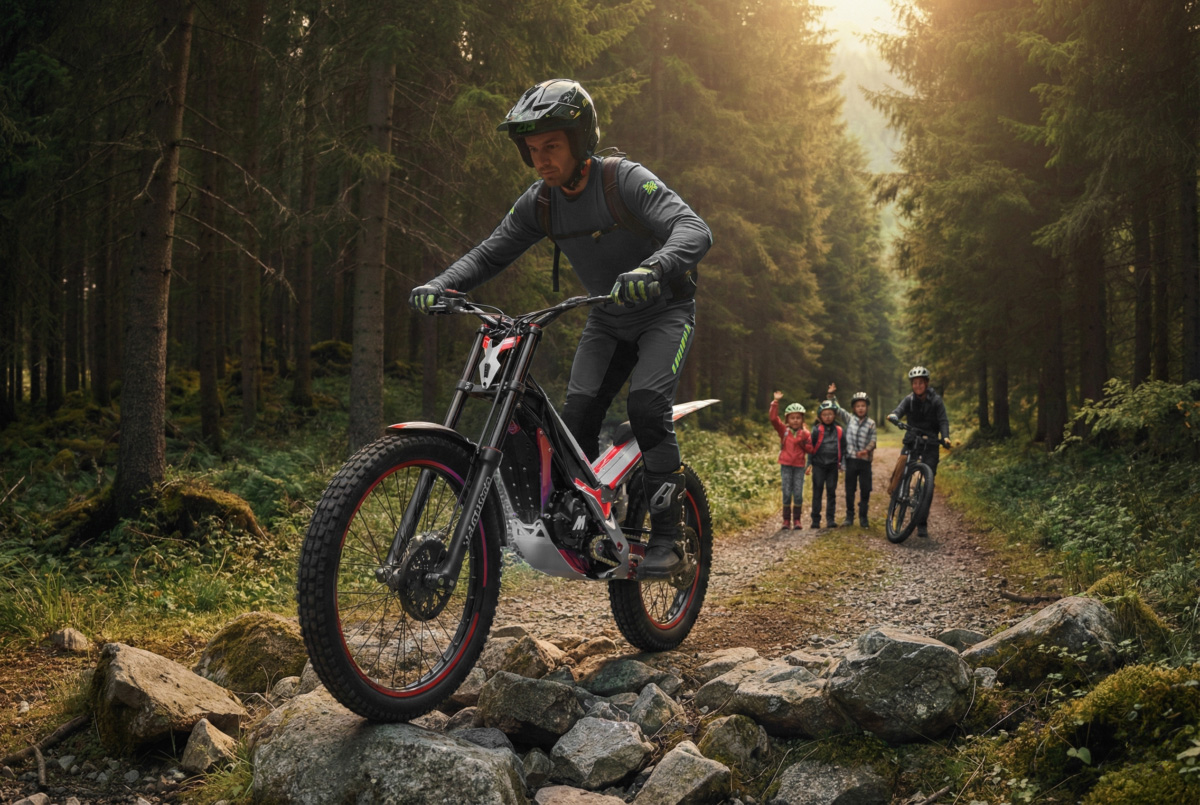
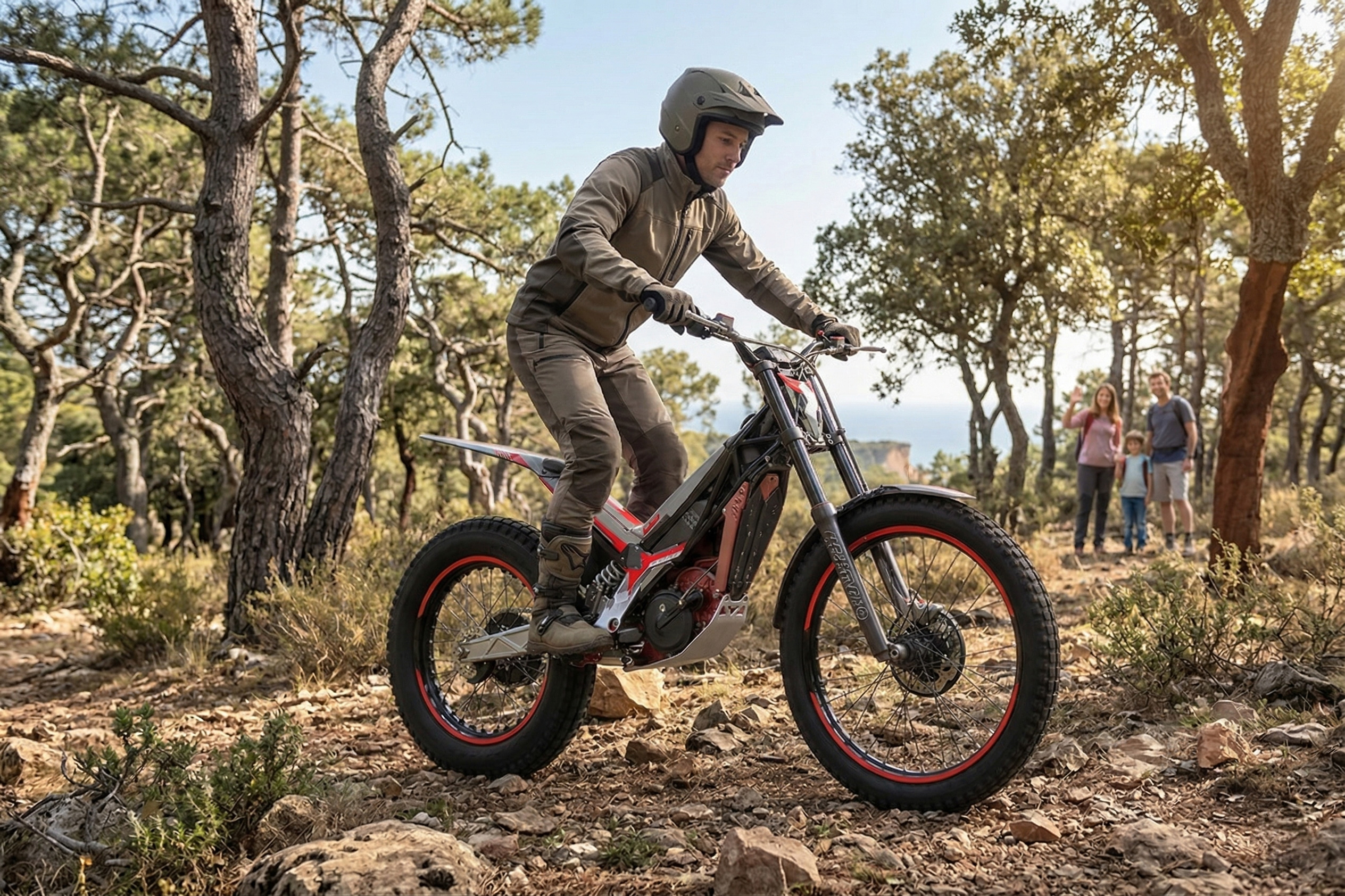
You arrive at the mountain, determined to tackle those sections that eluded you last time. You adjust your helmet, prepare for the first section, and just before starting the engine, doubt creeps in. It's not technical. It's not physical. It's the noise. You know that as soon as the engine roars, the surrounding silence will be shattered. And you know full well that you'll be exposed.
It's not the first time. Hikers who look disapprovingly. The odd awkward comment. Neighbors who associate your passion with a nuisance. New signs restricting access. Little by little, the map shrinks. Not because there are fewer sections, but because there are too many obstacles.
Then the uncomfortable question arises: what if the problem isn't the trials riding itself, but the engine? What if the technique, the balance, and the precision aren't the conflict, but the noise that accompanies them?
When the sound disappears, more than just the volume changes. The attitude of those around you changes. The perception changes. The frequency with which you decide to go out and train changes. The map expands again. And suddenly, the mountain feels like what it was always meant to be: a place to improve, enjoy, and flow without asking permission.
The real problem with mountain trials is not the sport
1. Noise: the real trigger for the restrictions
When discussing limitations on mountain trials, the debate is often framed as a conflict between sport and nature. But the reality is more concrete: the main historical trigger for restrictions hasn't been the sport itself, but the noise.
A combustion-engine trials bike generates an acoustic impact that spreads far beyond the rider. In high mountain environments, where silence is part of the landscape's value, the sound travels for kilometers. It doesn't just affect those near the trail; it alters the entire experience of the environment.
It's no coincidence that many regional and municipal regulations have started by limiting noise levels rather than prohibiting the discipline. Noise is immediate, perceptible, and above all, emotional. It's what triggers complaints from residents and political pressure.
The problem isn't that trials exists. The problem is that, for decades, the noise made it too visible—and annoying—for those who don't participate.
2. The perception of combustion engine motorcycles as polluting
Por si el ruido fuera poco, otro factor ha empeorado la imagen pública: la contaminación asociada a las motos de combustión.
As if the noise weren't enough, another factor has worsened the public image: the pollution associated with combustion engine motorcycles.
In the collective mind, a combustion engine motorcycle in the mountains represents emissions, the risk of spills, and environmental damage. This image has had more influence than the data. In a context where environmental awareness grows every year, any activity associated with fossil fuels starts at a disadvantage.
The debate isn't whether trials is legitimate as a discipline. The debate is whether the traditional technological model is compatible with current environmental sensitivities.
3. Conflicts with other users of the natural environment
The third axis of the conflict is not technical, but social: coexistence.
The mountains are no longer the sparsely populated space they once were. Hikers, cyclists, runners, families, ranchers, and athletes share the same paths. When different uses coincide in the same space, friction becomes inevitable.
For someone walking in search of tranquility, encountering a motorcycle can be perceived as an invasion. It doesn't matter if the rider is respectful or if the activity is permitted: the perception of risk and the disruption of the experience generate tension.
Many of the closures and restrictions have not arisen from impact studies, but from repeated conflicts between users. The problem has not been trials riding as a sport, but rather the management of coexistence in an increasingly crowded environment.
The real problem with trials riding is not the sport itself. The technique, the skill, and the surrounding culture are not in question. What is being questioned is the impact: the noise, the perception of pollution, and the coexistence.
When the debate is understood from this perspective, the solution is no longer to restrict, but to transform.
What changes when the protagonist ceases to be noise or smoke?
Here begins the true transformation.
1. Drastic Noise Reduction
Cuando conduces una moto eléctrica silenciosa en la montaña, el sonido deja de dominar la experiencia. Ya no irrumpes en el entorno: te integras en él. La ausencia de explosiones y vibraciones mecánicas genera una mayor sensibilidad al terreno. Escuchas la gravilla bajo las ruedas, el viento cruzando el casco, incluso pequeños cambios en la tracción que antes quedaban ocultos por el motor.
This drastic noise reduction improves your perception of the surface: you identify loose patches, wet roots, or changes in gradient more quickly. Riding becomes more precise, more technical, and more mindful. Furthermore, by eliminating auditory fatigue, concentration increases. It's not just about silence; it's about focus, mental clarity, and control.
2. Zero emissions
An emission-free electric motorcycle transforms your relationship with the landscape from the very first moment. There's no smoke, no smell of combustion, no visible trace in the air. This not only reduces the immediate environmental impact but also the feeling of aggression towards the environment.
In natural spaces, the threat isn't just physical; it's also sensory. Smoke and noise trigger an alert response in both wildlife and people. By eliminating them, the perceived risk decreases. Your presence becomes more discreet, less invasive. Passing along the trail no longer feels like an intrusion but begins to be perceived as a natural flow of traffic.
3. Greater integration with hikers and cyclists
Living together in the mountains depends largely on mutual perception. When noise disappears and there are no visible emissions, the interaction changes radically. The approach is gentler, less intimidating. A greeting replaces a reproachful glance.
Electric mobility facilitates a more natural integration with hikers and cyclists, reducing historical tensions associated with traditional motorcycling. The experience ceases to be a confrontation and becomes a shared one.
You are no longer a threat.
The new real map of electric trials
1. Sensitive Areas Where Noise Was the Limiting Factor
For years, the practice of trials riding has been limited by one crucial factor: noise. Many technically perfect areas—abandoned quarries, controlled forest areas, urban land, or private properties—were ruled out due to noise pollution.
When that barrier disappears, the question of where to practice electric trials changes. Spaces that were previously unsuitable due to noise impact become possible venues, always within regulations and with respect for the environment. The limit is no longer volume but technique. The map doesn't just expand in kilometers: it expands in real possibilities.
2. Training near urban areas
Electric trials bikes drastically reduce friction with the urban environment. Without the noise and fumes, training near populated areas is no longer a constant problem.
This opens the door to sessions in controlled areas close to the city: private land, compact circuits, and designated spaces where noise previously made any sustained activity impossible. The advantage is direct: fewer long journeys and more time on the bike. Training ceases to be a logistical undertaking and becomes much more accessible.
3. More Frequent and Spontaneous Sessions
When preparation is simplified and the impact is less, practice becomes more natural. There's no need to plan so far in advance or depend on restrictive schedules to avoid discomfort.
The result is shorter but more frequent sessions. Technical training during the week. Specific practice of balance or particular areas without turning every outing into an event. Progress increases because consistency pays off.
It's not just "more places," it's "more opportunities to practice."
Freedom does not mean the absence of rules
1. Local Regulations and Responsibility
Electric trials riding doesn't exist in a legal vacuum. Regulations for electric off-road motorcycles still depend on the specific area, land classification, forest management plans, and municipal ordinances. Just because a motorcycle doesn't emit smoke or generate high noise levels doesn't mean it can freely ride on any trail.
The difference lies elsewhere: by reducing the noise and environmental impact, the conflicts that have historically led to stricter restrictions are diminished. But responsibility remains individual. Staying informed about local regulations, respecting signage, and riding in authorized areas is what transforms technical freedom into social legitimacy.
Electric motorcycles expand possibilities, but the sector's credibility depends on the rider's behavior.
2. Coexistence as a Competitive Advantage
Electric mobility doesn't eliminate rules; it reduces friction. And that reduction is strategic. Less noise means fewer complaints. Fewer direct emissions mean less perceived aggression. This facilitates coexistence with hikers, cyclists, and local communities.
In a context where access to natural spaces is increasingly sensitive, the ability to integrate without generating rejection becomes a real competitive advantage. It's not just a technical issue, but a cultural one.
Respecting rules, anticipating conflicts, and prioritizing coexistence solidifies the practice of electric trials as a responsible evolution. Electricity doesn't eliminate limits; it reduces friction.
Which type of pilot notices this change the most?
1. Young pilots training in nearby environments
For young pilots, the change is fundamental. The ability to train in more accessible environments—always within permitted areas—reduces logistical and financial barriers. Fewer long commutes mean more actual practice time and greater weekly consistency. Can you imagine training every day after school?
Furthermore, reduced noise pollution facilitates social acceptance in urban areas or on private land, a crucial factor when relying on others for training. For a pilot in training, repetition leads to improvement. And when practice is more accessible, the learning curve accelerates.
2. Adults with Limited Free Time
Adult riders often face a scarce resource: time. Work, family, and other commitments limit the available training windows. In this context, reducing travel and simplifying planning makes a tangible difference.
Electric motorcycles allow for shorter, more focused sessions, without turning each ride into a logistical operation. Being able to practice technique for an hour during the week—with less impact and less friction with the environment—increases consistency. For this profile, the change isn't just technical: it's organizational.
3. Trial Schools
Schools perceive the impact even more clearly. Less noise means fewer neighborhood conflicts, greater operational stability, and easier agreements with property owners and local authorities.
Furthermore, the reduced sensory impact improves the learning experience: the instructor can communicate better with the student, provide real-time feedback, and create a more controlled environment. This professionalizes the training and facilitates the recruitment of new riders.
Gasoline vs. Electric in Access to Natural Spaces
The difference between gasoline and electric vehicles isn't limited to the type of engine; it manifests directly in how each technology is perceived and regulated in the natural environment.
A gasoline-powered motorcycle generates constant noise, vibrations, and visible emissions. These three factors immediately trigger a sense of impact: disturbance to wildlife, inconvenience to other users, and a direct environmental footprint. Consequently, there has historically been greater social and administrative pressure regarding their use in mountainous areas, leading to stricter restrictions and recurring conflicts.
In contrast, the electric motorcycle drastically reduces noise impact and eliminates direct emissions during use. The experience is no longer intrusive. This doesn't imply unrestricted access or a lack of regulation, but it does modify the perception of risk and threat associated with its presence. Where noise was once the main trigger for complaints, now the interaction is more discreet.
From a practical standpoint, gasoline requires a greater distance from populated areas and sensitive zones to avoid conflicts. Electric vehicles, by generating less friction, facilitate agreements, continuity of use, and stability in authorized spaces.
The key is not that electric vehicles “can go where gasoline cannot,” but rather that they reduce the social and operational barriers that limit access. In a context of increasingly stringent environmental regulations, technology that minimizes impact has a greater chance of coexisting.
Ultimately, the comparison is not merely mechanical; it is cultural and strategic: a lower perceived impact translates into greater long-term viability.